
ChatGPT Image Aug 17, 2026, 01_55_30 PM

How Pre-Med Graduates Can Move Into Canadian Medical Schools

Few questions matter more to a pre-med student than this one: how does this actually lead to medical school? It’s a fair question, and the honest answer requires being precise about what a Pre-Med program does — and doesn’t — do within Canada’s medical school admissions system.

The Canadian Medical School Reality

Canadian medical schools require applicants to hold a completed undergraduate degree (a small number consider exceptional applicants without one, but this is the exception, not the rule), competitive grades, MCAT scores at most schools, and a strong application demonstrating relevant experience — often including volunteering, research, or healthcare exposure. Requirements vary by school and province, so any serious applicant needs to check individual medical school websites directly rather than relying on general assumptions.

A career-college pre-med diploma is not a substitute for that undergraduate degree. What it is: a focused, faster way to build the foundational science knowledge — anatomy, physiology, biology, chemistry — that makes a subsequent degree program, and eventually medical school coursework, easier to succeed in.

Where a Pre-Med Diploma Actually Helps

Used correctly, a pre-med diploma functions as a launchpad in a few concrete ways:

  • Building a strong science foundation before university. Students who felt shaky in high school science often use a pre-med diploma to solidify fundamentals before starting (or restarting) an undergraduate science degree.
  • Confirming interest before committing years to a degree. Medical school is a long, expensive path. A shorter pre-med program lets students test whether they genuinely enjoy the material and the clinical mindset before investing in a full degree.
  • Supporting a pivot into allied health instead. Plenty of pre-med students discover they’re drawn to hands-on clinical work rather than the years-long physician track, and pivot into programs like Acupuncture or Manual Osteopathy — the science foundation transfers directly.

Building the Application Beyond Grades

Canadian medical schools consistently look for more than transcripts. Volunteer work, shadowing healthcare professionals, research experience, and demonstrated commitment to community health all strengthen an application. Students serious about medicine should start building this experience early — ideally well before they’re deep into an undergraduate degree — rather than scrambling to assemble it in their final year.

The MCAT and Standardized Testing

Most Canadian medical schools require MCAT scores as part of admission (a few, notably in Quebec, have different requirements). The exam covers biology, chemistry, physics, psychology, and critical reasoning — subjects a solid pre-med foundation directly supports, even though the MCAT itself is typically written after completing relevant undergraduate coursework, not immediately after a pre-med diploma.

Setting Realistic Timelines

A realistic path looks roughly like: pre-med foundation → undergraduate degree (typically 3-4 years) → MCAT and application → medical school (an additional 4 years) → residency. It’s a long road, and being clear-eyed about the timeline from the start helps students make informed decisions rather than assuming any single program is a shortcut around the full process.

Understanding How Competitive Admission Really Is

Canadian medical school admission is genuinely competitive, with far more qualified applicants than available seats at most schools each year. This isn’t meant to discourage serious students — it’s meant to set realistic expectations from the start. A strong GPA and MCAT score are necessary but often not sufficient on their own; admissions committees also weigh personal statements, references, interviews, and demonstrated commitment to healthcare or community service. Students who understand this early tend to build a more well-rounded application over several years, rather than scrambling in their final year of undergrad.

Alternative Paths Within Healthcare

Not every student who starts down a pre-med path ends up in medical school, and that’s a completely normal outcome rather than a failure. Some discover a genuine passion for research, others gravitate toward nursing or allied health professions, and others find hands-on clinical work — through programs like acupuncture or manual osteopathy — a better fit for how they want to practice healthcare day to day. A strong science foundation keeps all of these doors open rather than closing any of them off.

Advice From Students Who’ve Made the Transition

Students who’ve successfully moved from a pre-med foundation into a full degree program consistently mention the same theme: starting university science coursework already comfortable with foundational anatomy, physiology, and lab technique freed up mental bandwidth to focus on the genuinely new, harder material in their degree — rather than struggling to catch up on fundamentals while also learning everything else for the first time.

The Value of Early Healthcare Exposure

Students serious about medicine benefit significantly from early, direct exposure to healthcare environments — shadowing physicians, volunteering at hospitals or clinics, or working in patient-facing healthcare roles. This exposure does more than strengthen an eventual application; it helps students confirm, early, whether the day-to-day reality of clinical medicine genuinely matches their expectations, before investing years into the academic path.

Building Resilience for a Long Academic Journey

The path from a pre-med foundation to a practicing physician spans a decade or more when you count undergraduate study, medical school, and residency. Students who approach this realistically — building sustainable study habits, maintaining outside interests, and avoiding burnout early — tend to navigate the full journey more successfully than those who treat every single stage as a maximum-intensity sprint.

Talking to Current Medical Students and Physicians

One of the most valuable, and most underused, steps prospective pre-med students can take is speaking directly with current medical students or practicing physicians about their own path. These conversations often reveal practical realities — about admissions, workload, and career satisfaction — that go well beyond what any program brochure or general online research can offer.

Frequently Asked Questions

Can I get into medical school directly after a Pre-Med diploma? No — Canadian medical schools require a completed undergraduate degree. A pre-med diploma is a foundation that supports that longer academic path, not a replacement for it.

Is the MCAT required for all Canadian medical schools? Most require it, though requirements vary by school and province — always confirm directly with each school you’re applying to.

What if I decide medicine isn’t the right fit after starting Pre-Med? The science and lab foundation transfers well into other healthcare training paths, including hands-on clinical programs.

Starting the Path With Clear Eyes

The Pre-Med Program at Ruhani College is designed to give students an honest, solid academic foundation — not empty promises about shortcuts. For students serious about a future in medicine or allied health, that foundation is exactly where the real work should start.
ChatGPT Image Aug 7, 2026, 01_25_12 PM

Pre-Med Curriculum Explained: What Courses Will You Actually Take?

Pre-med isn’t a purely theoretical program. Lab sessions — chemistry lab work, biology dissections or specimen study, and hands-on physiology demonstrations — give students exposure to the kind of practical, evidence-based learning that university science programs also emphasize. This matters because medical schools and further academic programs expect applicants to already be comfortable with lab protocols, data recording, and basic scientific method.

Study Skills and Academic Preparation

A less obvious but genuinely important part of the curriculum is academic preparation itself: how to read dense scientific material efficiently, how to prepare for standardized, high-stakes exams, and how to manage a course load that moves faster than typical high school science classes. Students coming straight from secondary school often find this transition is the real adjustment — not the content itself, but the pace and independence required to keep up with it.

How the Curriculum Maps to Career Paths

Graduates use a pre-med foundation in a few different directions:

  • Building toward further academic study. Because Canadian medical schools require a completed undergraduate degree (typically alongside MCAT scores and a competitive application) for admission, a pre-med diploma works best as a head start on foundational science knowledge before or alongside that degree — not a replacement for it. Prospective applicants should always confirm specific admission requirements directly with individual medical schools.
  • Entering allied health fields. The anatomy, physiology, and lab skills built in a pre-med program transfer directly into other healthcare training paths, including programs like Acupuncture or Manual Osteopathy, for students who decide a hands-on clinical career suits them better than the traditional medical school route.
  • Strengthening a weak academic transcript. Students who didn’t take strong science courses in secondary school sometimes use a pre-med program to fill that gap before applying to competitive university programs.

What a Typical Week Looks Like

Expect a mix of lecture-based instruction, lab sessions, and independent study time. Because the program is compressed compared to a full degree, the pace is faster — students who thrive tend to be the ones who stay consistent with review rather than cramming before assessments.

Assessment Style: What Exams Actually Look Like

Pre-med coursework typically moves away from simple multiple-choice memorization tests toward assessments that mirror what future science and medical coursework will demand — applying concepts to scenarios, interpreting data, and explaining physiological processes in your own words. Lab reports and practical assessments carry real weight alongside written exams. Students who adapt early to this style of testing, rather than relying purely on memorization, tend to perform more consistently as the program progresses.

Time Management in a Compressed Program

Because a pre-med diploma condenses foundational science into a shorter timeframe than a full degree, time management becomes a genuine skill students need to develop, not just an abstract piece of advice. Successful students typically build a consistent weekly review routine rather than relying on last-minute cramming before exams — reviewing lecture material within a day or two while it’s still fresh dramatically improves retention compared to revisiting it only before a test.

How Instructors Support the Transition

Smaller class sizes typical of career-college programs mean students generally have more direct access to instructors than in large university lecture halls. This matters most in the early weeks, when students are still adjusting to the pace — asking questions in the moment, rather than letting confusion compound over several classes, is one of the most effective habits a new pre-med student can build.

Connecting Pre-Med Knowledge to Real Healthcare Scenarios

The strongest pre-med programs go beyond isolated facts and actively connect coursework to real clinical scenarios — explaining, for instance, not just the structure of th“What will I actually study?” is the first question most students ask before enrolling in a Pre-Med program, and it’s a fair one. Unlike a general science degree, a pre-med diploma is built specifically around the foundational knowledge future medical students, researchers, and healthcare professionals need — without the unrelated electives a full university degree requires.

The Core Science Foundation

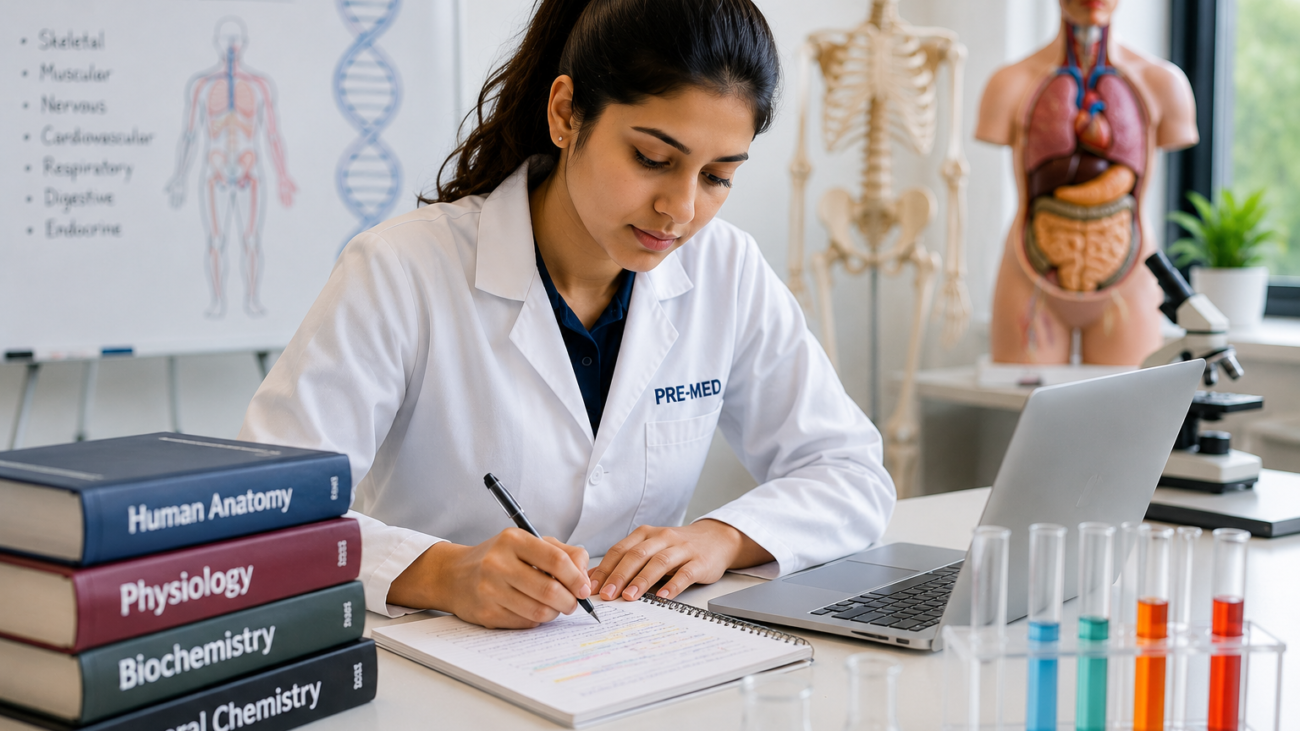
Every pre-med curriculum is anchored in the same handful of subjects that medical schools expect applicants to have a solid grip on: human anatomy and physiology, biology, chemistry, and an introduction to biochemistry. These aren’t taught as isolated theory — a well-structured program ties each subject back to how the human body actually functions, so the material sticks rather than becoming something memorized for a test and forgotten.

Anatomy and physiology in particular deserve attention, because they form the mental map students carry into every future healthcare setting — whether that’s a hospital ward, a research lab, or a clinical practice. Students learn body systems (cardiovascular, respiratory, nervous, musculoskeletal, and more) and how they interact, which becomes essential once they’re interpreting patient cases in later training.

Lab and Practical Components

e cardiovascular system, but how that knowledge applies to understanding a patient presenting with chest pain or shortness of breath. This applied framing helps material stick, and it gives students an early, honest preview of how foundational science actually gets used in clinical decision-making later in their careers.

Preparing for What Comes Next

Whether a student’s next step is a full undergraduate degree, an allied health program, or further exploration of career options, the habits built during a pre-med program — consistent review, comfort with lab protocols, and confidence discussing scientific concepts — carry forward directly. Students who leave a strong pre-med foundation with these habits intact, not just a transcript, tend to adapt faster to whatever academic environment comes next.

Choosing the Right Program Fit

Not every pre-med program is structured identically, and prospective students should look closely at how much of the curriculum is lecture-based versus lab-based, class sizes, and instructor clinical backgrounds before enrolling. A program taught by instructors with genuine healthcare experience — not purely academic backgrounds — often gives students a more grounded, applied understanding of how the material connects to real clinical practice down the road.

Frequently Asked Questions

Does a Pre-Med diploma guarantee admission to medical school? No program can guarantee medical school admission. Canadian medical schools set their own competitive requirements, typically including a completed undergraduate degree, MCAT scores, and interviews. A pre-med diploma builds foundational science knowledge that supports that longer journey.

Is the Pre-Med program only useful for students who want to become doctors? No — the science and lab foundation is equally useful for students considering nursing, allied health, research, or other clinical training paths.

How is a career-college Pre-Med program different from university pre-med courses? It’s more compressed and career-focused, without the general education electives a full degree requires, making it a faster way to build core science knowledge.

Where This Fits at Ruhani College

The Pre-Med Program at Ruhani College is designed by instructors with real clinical and academic backgrounds, so students get a grounded, honest introduction to the science that underpins every healthcare career — whether their next step is a university degree or a hands-on clinical program.