ChatGPT Image Aug 17, 2026, 06_24_58 PM

Traditional vs Modern Techniques Taught in Acupuncture Diploma Programs

Acupuncture has been practiced for centuries and is traditionally associated with Traditional Chinese Medicine (TCM). Over time, acupuncture education has evolved to include modern clinical knowledge, safety practices, anatomy, and technology-based techniques.

Today, an acupuncture techniques diploma can introduce students to both traditional principles and contemporary approaches. Understanding the difference between these techniques can help students choose a program that provides a balanced foundation in theory, practical skills, and clinical application.

The World Health Organization (WHO) has developed benchmarks for acupuncture training that can be used as a reference for education providers and practitioners.

What Are Traditional Acupuncture Techniques?

Traditional acupuncture is based on concepts that have developed within Chinese medicine over many centuries. Students generally learn about meridians, acupuncture points, Qi, traditional diagnostic approaches, and classical treatment principles.

Common traditional techniques include:

1. Manual Acupuncture

Manual acupuncture involves inserting fine needles into selected acupuncture points and applying controlled manual stimulation. Students learn important skills such as locating points, selecting appropriate needles, controlling insertion depth, and using safe needling techniques.

2. Moxibustion

Moxibustion involves the application of heat, traditionally using processed mugwort, near specific acupuncture points. It is taught as a complementary technique within traditional acupuncture practice.

3. Cupping

Cupping uses cups placed on the skin to create suction. It is commonly taught alongside acupuncture and other traditional techniques as part of broader TCM-based treatment approaches.

4. Auricular Acupuncture

Auricular acupuncture focuses on points located on the ear. Students may learn point identification and the principles behind using ear-based acupuncture approaches.

5. Traditional Diagnosis

Traditional acupuncture education may include methods such as pulse assessment, observation, and tongue examination. These approaches are taught as part of understanding the traditional diagnostic framework.

Traditional acupuncture programs can provide extensive exposure to TCM principles and classical approaches. However, the exact curriculum varies considerably between institutions and countries.

What Are Modern Acupuncture Techniques?

Modern acupuncture education increasingly combines traditional needling skills with contemporary clinical knowledge and technology.

Modern approaches may include:

1. Electroacupuncture

Electroacupuncture uses a small electrical stimulation through acupuncture needles. Students may learn the basic principles, equipment handling, safety considerations, and appropriate clinical application under supervision.

2. Modern Anatomical Approach

Instead of relying only on traditional point descriptions, modern training can also teach students anatomy and physiology. This helps students understand muscles, nerves, blood vessels, and other anatomical structures relevant to safe clinical practice.

3. Evidence-Informed Clinical Practice

Modern acupuncture programs may introduce students to clinical research, scientific terminology, treatment documentation, patient assessment, and evidence-informed practice. This can help students understand how acupuncture is studied and applied within contemporary healthcare.

4. Contemporary Safety and Hygiene

Sterile, single-use needles, proper hand hygiene, safe disposal of sharps, infection-control procedures, and patient assessment are important parts of responsible acupuncture training.

5. Clinical Case-Based Learning

Modern education may use patient cases to help students connect theory with practical decision-making. Students can learn how to assess a patient, identify relevant considerations, develop a treatment plan, and monitor the response to treatment under appropriate supervision.

Traditional vs Modern Acupuncture Techniques

Traditional TechniquesModern Techniques
Based strongly on TCM principlesCombines acupuncture with contemporary healthcare knowledge
Focuses on meridians and traditional acupuncture pointsIncludes anatomy, physiology, and clinical assessment
Manual needle stimulationMay include electroacupuncture and other contemporary approaches
Moxibustion and cuppingModern equipment and standardized clinical procedures
Traditional diagnostic methodsGreater emphasis on documentation and evidence-informed practice
Classical treatment theoriesCase-based and clinically oriented learning

A strong educational approach does not necessarily require choosing one over the other. Modern acupuncture education can combine traditional knowledge with contemporary clinical training. Research on acupuncture education has also highlighted the potential value of integrating traditional and medical acupuncture pathways.

Why Learn Both Traditional and Modern Techniques?

Learning both approaches can give students a broader understanding of acupuncture.

Better Understanding of Acupuncture Principles

Traditional concepts help students understand the historical and theoretical foundation of acupuncture, including meridians, acupuncture points, and TCM-based treatment principles.

Stronger Practical Skills

Hands-on training helps students develop important practical skills such as point location, needle handling, insertion technique, and patient positioning.

Greater Clinical Awareness

Modern subjects such as anatomy, physiology, hygiene, patient assessment, and clinical documentation can support safer and more structured learning.

Adaptability

Healthcare continues to evolve. Students who understand both traditional principles and contemporary approaches may be better prepared to learn different acupuncture techniques throughout their professional development.

What Should You Look for in an Acupuncture Techniques Diploma?

When choosing an acupuncture techniques diploma, students should look beyond the course title. A good program should clearly explain what theoretical and practical training it provides.

Consider looking for:

  • Traditional acupuncture theory and principles
  • Meridian and acupuncture point education
  • Anatomy and physiology
  • Practical needling training
  • Infection-control and safety procedures
  • Clinical observation or supervised practice
  • Patient assessment and treatment planning
  • Exposure to contemporary acupuncture techniques
  • Qualified and experienced instructors
  • A clearly defined curriculum and assessment process

The WHO’s acupuncture training benchmarks emphasize structured learning requirements and competencies for different categories of acupuncture providers.

Acupuncture Techniques Diploma at Ruhani College

At Ruhani College of Health Business and Technology, students interested in acupuncture can build their understanding through structured education covering traditional principles alongside practical and contemporary approaches.

A well-rounded learning experience should help students understand the foundations of acupuncture while developing practical awareness, professional discipline, and patient-safety skills.

For students considering acupuncture as a career or complementary healthcare skill, choosing a program with both theoretical education and practical exposure can be an important step toward building confidence and competence.

Traditional and Modern Techniques: Which One Is Better?

There is no simple answer because traditional and modern approaches serve different educational purposes.

Traditional techniques provide the foundation of acupuncture theory and preserve classical knowledge. Modern techniques add contemporary clinical concepts, technology, safety procedures, and evidence-informed learning.

For students, the most useful approach can be a balanced curriculum that teaches traditional principles while also preparing them for modern clinical environments.

Career Scope After an Acupuncture Techniques Diploma

The career opportunities available after completing an acupuncture program depend on the qualification, local regulations, professional registration requirements, and the individual’s existing healthcare credentials.

Depending on their background and applicable regulations, learners may explore opportunities in:

  • Wellness and complementary healthcare settings
  • Acupuncture clinics
  • Integrative healthcare environments
  • Rehabilitation and supportive care settings
  • Holistic wellness centres
  • Further education and specialization

Students should always verify the legal scope of practice and professional requirements applicable in their location before beginning clinical practice. This is particularly important in India, where acupuncture education and professional regulation have historically had an inconsistent framework.

Frequently Asked Questions

1. What is an acupuncture techniques diploma?

An acupuncture techniques diploma is a structured educational program designed to teach the theory and practical foundations of acupuncture. Depending on the institution, it may cover traditional acupuncture, modern techniques, anatomy, safety, patient assessment, and clinical practice.

2. What traditional techniques are taught in acupuncture diploma programs?

Traditional techniques may include manual acupuncture, moxibustion, cupping, auricular acupuncture, meridian theory, acupuncture point location, and traditional diagnostic concepts.

3. What modern techniques are included in acupuncture training?

Depending on the curriculum, modern techniques may include electroacupuncture, contemporary anatomical approaches, evidence-informed clinical practice, modern hygiene procedures, and case-based clinical training.

4. Is anatomy taught in an acupuncture diploma?

Many structured acupuncture programs include anatomy and physiology because understanding the human body is important for safe and informed clinical training. However, the exact subjects depend on the institution and qualification.

5. Is practical training important in an acupuncture techniques diploma?

Yes. Acupuncture is a hands-on discipline, so practical learning is an important part of developing skills such as point location, safe needle handling, insertion technique, and patient assessment.

6. Can beginners study an acupuncture techniques diploma?

Eligibility varies between institutions. Some programs may accept beginners, while others may require previous healthcare education or professional experience. Students should check the specific admission requirements of the college.

7. Should I learn traditional or modern acupuncture techniques?

Learning both can provide a broader educational foundation. Traditional techniques explain the classical principles of acupuncture, while modern approaches introduce contemporary clinical knowledge, safety, and technology.

8. Why choose Ruhani College for acupuncture education?

Ruhani College of Health Business and Technology can be considered by students looking for structured education in healthcare-related fields. Prospective students should review the current course curriculum, eligibility, practical training, faculty, certification, and applicable professional requirements before enrolling.

Conclusion

The field of acupuncture continues to combine traditional knowledge with modern approaches to education and clinical practice. Traditional techniques such as manual acupuncture, moxibustion, cupping, and auricular acupuncture provide an important foundation, while modern approaches can introduce electroacupuncture, anatomy, clinical assessment, safety procedures, and evidence-informed learning.

For students searching for an acupuncture techniques diploma, the ideal program should offer a balanced combination of theory and practical education. Understanding both traditional and modern approaches can help students develop a broader perspective and prepare for continued learning in the field of acupuncture.

ChatGPT Image Aug 17, 2026, 01_55_30 PM

How Pre-Med Graduates Can Move Into Canadian Medical Schools

Few questions matter more to a pre-med student than this one: how does this actually lead to medical school? It’s a fair question, and the honest answer requires being precise about what a Pre-Med program does — and doesn’t — do within Canada’s medical school admissions system.

The Canadian Medical School Reality

Canadian medical schools require applicants to hold a completed undergraduate degree (a small number consider exceptional applicants without one, but this is the exception, not the rule), competitive grades, MCAT scores at most schools, and a strong application demonstrating relevant experience — often including volunteering, research, or healthcare exposure. Requirements vary by school and province, so any serious applicant needs to check individual medical school websites directly rather than relying on general assumptions.

A career-college pre-med diploma is not a substitute for that undergraduate degree. What it is: a focused, faster way to build the foundational science knowledge — anatomy, physiology, biology, chemistry — that makes a subsequent degree program, and eventually medical school coursework, easier to succeed in.

Where a Pre-Med Diploma Actually Helps

Used correctly, a pre-med diploma functions as a launchpad in a few concrete ways:

  • Building a strong science foundation before university. Students who felt shaky in high school science often use a pre-med diploma to solidify fundamentals before starting (or restarting) an undergraduate science degree.
  • Confirming interest before committing years to a degree. Medical school is a long, expensive path. A shorter pre-med program lets students test whether they genuinely enjoy the material and the clinical mindset before investing in a full degree.
  • Supporting a pivot into allied health instead. Plenty of pre-med students discover they’re drawn to hands-on clinical work rather than the years-long physician track, and pivot into programs like Acupuncture or Manual Osteopathy — the science foundation transfers directly.

Building the Application Beyond Grades

Canadian medical schools consistently look for more than transcripts. Volunteer work, shadowing healthcare professionals, research experience, and demonstrated commitment to community health all strengthen an application. Students serious about medicine should start building this experience early — ideally well before they’re deep into an undergraduate degree — rather than scrambling to assemble it in their final year.

The MCAT and Standardized Testing

Most Canadian medical schools require MCAT scores as part of admission (a few, notably in Quebec, have different requirements). The exam covers biology, chemistry, physics, psychology, and critical reasoning — subjects a solid pre-med foundation directly supports, even though the MCAT itself is typically written after completing relevant undergraduate coursework, not immediately after a pre-med diploma.

Setting Realistic Timelines

A realistic path looks roughly like: pre-med foundation → undergraduate degree (typically 3-4 years) → MCAT and application → medical school (an additional 4 years) → residency. It’s a long road, and being clear-eyed about the timeline from the start helps students make informed decisions rather than assuming any single program is a shortcut around the full process.

Understanding How Competitive Admission Really Is

Canadian medical school admission is genuinely competitive, with far more qualified applicants than available seats at most schools each year. This isn’t meant to discourage serious students — it’s meant to set realistic expectations from the start. A strong GPA and MCAT score are necessary but often not sufficient on their own; admissions committees also weigh personal statements, references, interviews, and demonstrated commitment to healthcare or community service. Students who understand this early tend to build a more well-rounded application over several years, rather than scrambling in their final year of undergrad.

Alternative Paths Within Healthcare

Not every student who starts down a pre-med path ends up in medical school, and that’s a completely normal outcome rather than a failure. Some discover a genuine passion for research, others gravitate toward nursing or allied health professions, and others find hands-on clinical work — through programs like acupuncture or manual osteopathy — a better fit for how they want to practice healthcare day to day. A strong science foundation keeps all of these doors open rather than closing any of them off.

Advice From Students Who’ve Made the Transition

Students who’ve successfully moved from a pre-med foundation into a full degree program consistently mention the same theme: starting university science coursework already comfortable with foundational anatomy, physiology, and lab technique freed up mental bandwidth to focus on the genuinely new, harder material in their degree — rather than struggling to catch up on fundamentals while also learning everything else for the first time.

The Value of Early Healthcare Exposure

Students serious about medicine benefit significantly from early, direct exposure to healthcare environments — shadowing physicians, volunteering at hospitals or clinics, or working in patient-facing healthcare roles. This exposure does more than strengthen an eventual application; it helps students confirm, early, whether the day-to-day reality of clinical medicine genuinely matches their expectations, before investing years into the academic path.

Building Resilience for a Long Academic Journey

The path from a pre-med foundation to a practicing physician spans a decade or more when you count undergraduate study, medical school, and residency. Students who approach this realistically — building sustainable study habits, maintaining outside interests, and avoiding burnout early — tend to navigate the full journey more successfully than those who treat every single stage as a maximum-intensity sprint.

Talking to Current Medical Students and Physicians

One of the most valuable, and most underused, steps prospective pre-med students can take is speaking directly with current medical students or practicing physicians about their own path. These conversations often reveal practical realities — about admissions, workload, and career satisfaction — that go well beyond what any program brochure or general online research can offer.

Frequently Asked Questions

Can I get into medical school directly after a Pre-Med diploma? No — Canadian medical schools require a completed undergraduate degree. A pre-med diploma is a foundation that supports that longer academic path, not a replacement for it.

Is the MCAT required for all Canadian medical schools? Most require it, though requirements vary by school and province — always confirm directly with each school you’re applying to.

What if I decide medicine isn’t the right fit after starting Pre-Med? The science and lab foundation transfers well into other healthcare training paths, including hands-on clinical programs.

Starting the Path With Clear Eyes

The Pre-Med Program at Ruhani College is designed to give students an honest, solid academic foundation — not empty promises about shortcuts. For students serious about a future in medicine or allied health, that foundation is exactly where the real work should start.

ChatGPT Image Aug 7, 2026, 01_25_12 PM

Pre-Med Curriculum Explained: What Courses Will You Actually Take?

Pre-med isn’t a purely theoretical program. Lab sessions — chemistry lab work, biology dissections or specimen study, and hands-on physiology demonstrations — give students exposure to the kind of practical, evidence-based learning that university science programs also emphasize. This matters because medical schools and further academic programs expect applicants to already be comfortable with lab protocols, data recording, and basic scientific method.

Study Skills and Academic Preparation

A less obvious but genuinely important part of the curriculum is academic preparation itself: how to read dense scientific material efficiently, how to prepare for standardized, high-stakes exams, and how to manage a course load that moves faster than typical high school science classes. Students coming straight from secondary school often find this transition is the real adjustment — not the content itself, but the pace and independence required to keep up with it.

How the Curriculum Maps to Career Paths

Graduates use a pre-med foundation in a few different directions:

  • Building toward further academic study. Because Canadian medical schools require a completed undergraduate degree (typically alongside MCAT scores and a competitive application) for admission, a pre-med diploma works best as a head start on foundational science knowledge before or alongside that degree — not a replacement for it. Prospective applicants should always confirm specific admission requirements directly with individual medical schools.
  • Entering allied health fields. The anatomy, physiology, and lab skills built in a pre-med program transfer directly into other healthcare training paths, including programs like Acupuncture or Manual Osteopathy, for students who decide a hands-on clinical career suits them better than the traditional medical school route.
  • Strengthening a weak academic transcript. Students who didn’t take strong science courses in secondary school sometimes use a pre-med program to fill that gap before applying to competitive university programs.

What a Typical Week Looks Like

Expect a mix of lecture-based instruction, lab sessions, and independent study time. Because the program is compressed compared to a full degree, the pace is faster — students who thrive tend to be the ones who stay consistent with review rather than cramming before assessments.

Assessment Style: What Exams Actually Look Like

Pre-med coursework typically moves away from simple multiple-choice memorization tests toward assessments that mirror what future science and medical coursework will demand — applying concepts to scenarios, interpreting data, and explaining physiological processes in your own words. Lab reports and practical assessments carry real weight alongside written exams. Students who adapt early to this style of testing, rather than relying purely on memorization, tend to perform more consistently as the program progresses.

Time Management in a Compressed Program

Because a pre-med diploma condenses foundational science into a shorter timeframe than a full degree, time management becomes a genuine skill students need to develop, not just an abstract piece of advice. Successful students typically build a consistent weekly review routine rather than relying on last-minute cramming before exams — reviewing lecture material within a day or two while it’s still fresh dramatically improves retention compared to revisiting it only before a test.

How Instructors Support the Transition

Smaller class sizes typical of career-college programs mean students generally have more direct access to instructors than in large university lecture halls. This matters most in the early weeks, when students are still adjusting to the pace — asking questions in the moment, rather than letting confusion compound over several classes, is one of the most effective habits a new pre-med student can build.

Connecting Pre-Med Knowledge to Real Healthcare Scenarios

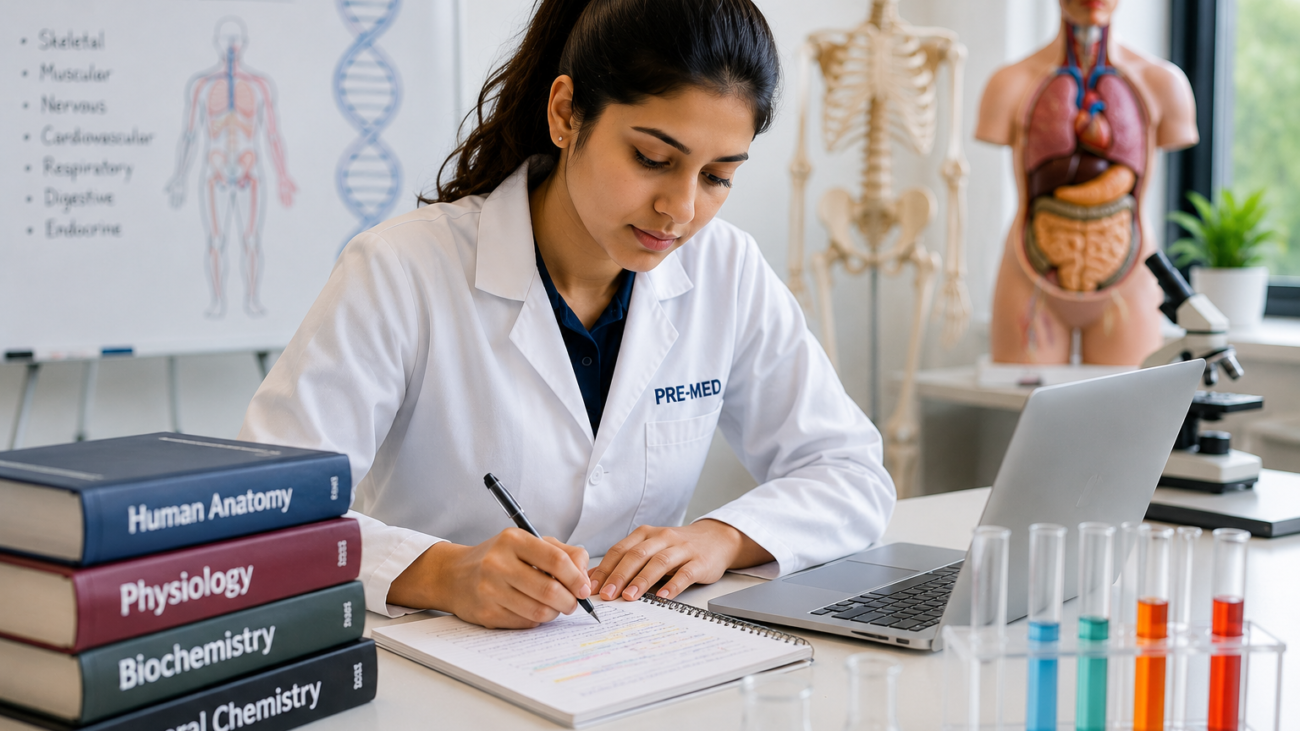
The strongest pre-med programs go beyond isolated facts and actively connect coursework to real clinical scenarios — explaining, for instance, not just the structure of th“What will I actually study?” is the first question most students ask before enrolling in a Pre-Med program, and it’s a fair one. Unlike a general science degree, a pre-med diploma is built specifically around the foundational knowledge future medical students, researchers, and healthcare professionals need — without the unrelated electives a full university degree requires.

The Core Science Foundation

Every pre-med curriculum is anchored in the same handful of subjects that medical schools expect applicants to have a solid grip on: human anatomy and physiology, biology, chemistry, and an introduction to biochemistry. These aren’t taught as isolated theory — a well-structured program ties each subject back to how the human body actually functions, so the material sticks rather than becoming something memorized for a test and forgotten.

Anatomy and physiology in particular deserve attention, because they form the mental map students carry into every future healthcare setting — whether that’s a hospital ward, a research lab, or a clinical practice. Students learn body systems (cardiovascular, respiratory, nervous, musculoskeletal, and more) and how they interact, which becomes essential once they’re interpreting patient cases in later training.

Lab and Practical Components

e cardiovascular system, but how that knowledge applies to understanding a patient presenting with chest pain or shortness of breath. This applied framing helps material stick, and it gives students an early, honest preview of how foundational science actually gets used in clinical decision-making later in their careers.

Preparing for What Comes Next

Whether a student’s next step is a full undergraduate degree, an allied health program, or further exploration of career options, the habits built during a pre-med program — consistent review, comfort with lab protocols, and confidence discussing scientific concepts — carry forward directly. Students who leave a strong pre-med foundation with these habits intact, not just a transcript, tend to adapt faster to whatever academic environment comes next.

Choosing the Right Program Fit

Not every pre-med program is structured identically, and prospective students should look closely at how much of the curriculum is lecture-based versus lab-based, class sizes, and instructor clinical backgrounds before enrolling. A program taught by instructors with genuine healthcare experience — not purely academic backgrounds — often gives students a more grounded, applied understanding of how the material connects to real clinical practice down the road.

Frequently Asked Questions

Does a Pre-Med diploma guarantee admission to medical school? No program can guarantee medical school admission. Canadian medical schools set their own competitive requirements, typically including a completed undergraduate degree, MCAT scores, and interviews. A pre-med diploma builds foundational science knowledge that supports that longer journey.

Is the Pre-Med program only useful for students who want to become doctors? No — the science and lab foundation is equally useful for students considering nursing, allied health, research, or other clinical training paths.

How is a career-college Pre-Med program different from university pre-med courses? It’s more compressed and career-focused, without the general education electives a full degree requires, making it a faster way to build core science knowledge.

Where This Fits at Ruhani College

The Pre-Med Program at Ruhani College is designed by instructors with real clinical and academic backgrounds, so students get a grounded, honest introduction to the science that underpins every healthcare career — whether their next step is a university degree or a hands-on clinical program.

Gemini_Generated_Image_h0w77ch0w77ch0w7

7 Effective Study Strategies for Adult Learners and Career College Students

Returning to school as an adult can be both exciting and challenging. Many mature students balance coursework with employment, family responsibilities, and other commitments, making effective study strategies essential for academic success.

The good news is that academic performance is not simply determined by intelligence or natural ability. Research in educational psychology consistently shows that effective study strategies have a significant impact on learning, retention, and long-term success.

The following evidence-based techniques can help adult learners maximize their study time and improve academic outcomes.

Move Beyond Passive Studying

Many students spend hours reading textbooks, highlighting notes, and reviewing course materials. While these activities can be useful as part of a study plan, they are often insufficient on their own.

Research has shown that passive review can create a false sense of familiarity with content without improving long-term retention. Students may recognize information while reading but struggle to recall or apply it during tests, assignments, or workplace situations.

Instead, learners should focus on active engagement with course material by asking questions, summarizing concepts in their own words, and testing their understanding regularly.

Use Active Recall to Improve Retention

One of the most effective learning strategies is active recall.

Rather than repeatedly reading notes, students attempt to retrieve information from memory without looking at their materials. This process strengthens memory pathways and improves long-term retention.

Examples of active recall include:

  • Answering practice questions
  • Completing quizzes
  • Using flashcards
  • Explaining concepts aloud
  • Writing summaries from memory

Research consistently demonstrates that active recall produces better learning outcomes than passive review techniques.

Practice with Multiple Question Formats

Successful students do not rely on a single type of practice material.

Exposure to a variety of question formats helps learners develop a deeper understanding of concepts and improves their ability to apply knowledge in different contexts.

Effective practice materials may include:

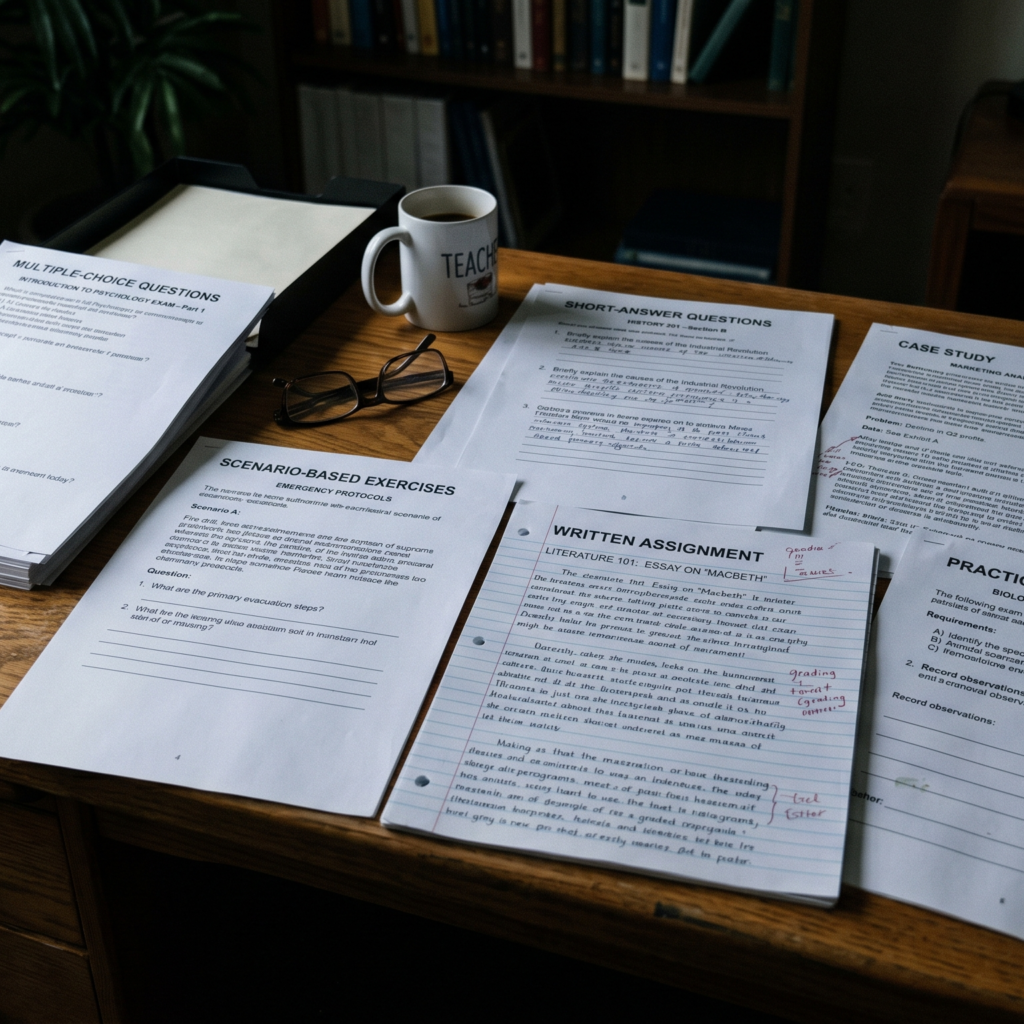
  • Multiple-choice questions
  • Short-answer questions
  • Case studies
  • Scenario-based exercises
  • Written assignments
  • Practical applications

This approach is particularly valuable in career-focused education, where students must demonstrate both theoretical knowledge and practical problem-solving skills.

Focus on One Concept Through Repeated Application

When students encounter challenging topics, the solution is often not more reading but more application.

Working through multiple questions related to a single concept helps learners identify gaps in understanding and view the material from different perspectives.

For example, rather than reviewing the same notes repeatedly, students should solve a variety of problems that require them to apply the concept in different situations.

This process builds confidence, strengthens critical thinking skills, and promotes deeper understanding.

Apply Spaced Repetition

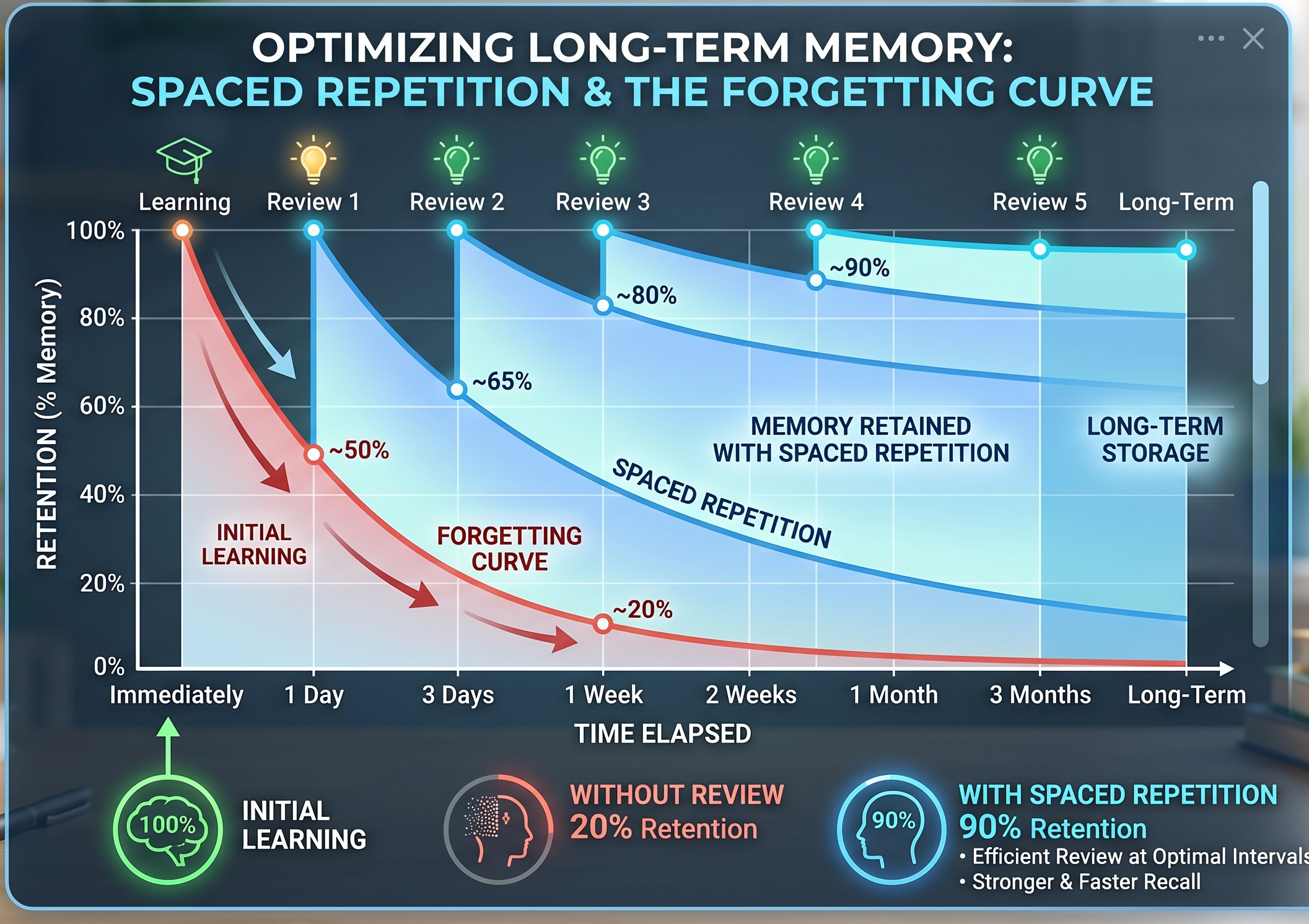
One of the most widely supported findings in learning science is the spacing effect.

Information is more likely to be retained when reviewed at intervals over time rather than studied intensively in a single session.

A simple spaced repetition schedule may involve:

  • Reviewing material shortly after class
  • Revisiting it the following day
  • Reviewing again several days later
  • Testing knowledge periodically over subsequent weeks

This method reduces forgetting and improves long-term retention.

Effective Study Strategies Spaced Recall Method

Prepare Before Class

Pre-class preparation can significantly improve learning outcomes.

Students who review lecture materials, readings, or introductory resources before class often find it easier to follow instruction and engage with complex topics.

Even a brief review session can provide important context, allowing learners to focus on understanding rather than trying to absorb entirely new information for the first time.

For busy adult learners, 15 to 20 minutes of preparation before a class can improve comprehension and reduce study time later.

Make Learning Flexible

Many adult learners must balance their studies with work and family commitments. As a result, flexibility becomes an important part of academic success.

Effective students often take advantage of small pockets of time throughout the day by:

  • Reviewing flashcards during commutes
  • Listening to educational content while travelling
  • Completing short study sessions between responsibilities
  • Using mobile learning tools to reinforce concepts

Consistency is often more important than lengthy study sessions.

Study Smarter, Not Longer

Academic success is rarely the result of simply spending more hours studying. Instead, it depends on using proven learning strategies that improve understanding, retention, and application.

For adult learners and career college students, the most effective study techniques include:

  • Active recall
  • Practice questions
  • Multiple question formats
  • Spaced repetition
  • Pre-class preparation
  • Consistent review habits

By adopting evidence-based learning strategies, students can make better use of their study time, improve academic performance, and build the knowledge and skills needed for long-term career success.

Gemini_Generated_Image_adf36eadf36eadf3

Beating Procrastination: 4 Tips for Career College Students

Why Do Students Procrastinate?

Beating procrastination is a challenge many career college students face while balancing school, work, and family responsibilities.

You come home after a long shift feeling exhausted. An assignment isn’t due until next week, so you decide to relax and tackle it tomorrow.

The next morning arrives. You feel refreshed and have some free time before starting your day. It seems like the perfect opportunity to begin your assignment. Instead, you find yourself scrolling through social media, watching videos, or catching up on other activities. Before you know it, the opportunity is gone.

As the days pass, other responsibilities take priority. Work commitments, family obligations, and unexpected events fill your schedule. Suddenly, the deadline is only a few days away. Stress begins to build, and what could have been a manageable task now feels overwhelming.

Many students know this cycle all too well. The good news is that procrastination is not a permanent habit. With the right strategies, it can be overcome.

Understanding Procrastination

Contrary to popular belief, procrastination is rarely caused by laziness. More often, it stems from feelings of anxiety, uncertainty, or being overwhelmed by the size or difficulty of a task.

When an assignment seems too large, too challenging, or too time-consuming, our brains naturally seek easier and more enjoyable activities instead. Unfortunately, delaying the task often increases stress and makes it even harder to start later.

The key to overcoming procrastination is reducing the mental barrier to getting started.

1. Focus on Small Wins

One of the most effective ways to overcome procrastination is to break large tasks into smaller, manageable pieces.

Instead of thinking about completing an entire assignment, focus on one small step:

  • Review your class notes for 15 minutes.
  • Read a single chapter.
  • Complete one practice question.
  • Create an outline for your assignment.

Small accomplishments build momentum. Once you’ve started, it becomes much easier to continue working. Many students discover that the hardest part is simply taking the first step.

This approach also helps reduce anxiety by transforming a large, intimidating project into a series of achievable tasks.

beating-procrastination-colorful-class-notes

2. Make Studying More Engaging

Successful study habits don’t have to be boring.

Students are more likely to stay consistent when they create a learning environment they enjoy. Consider:

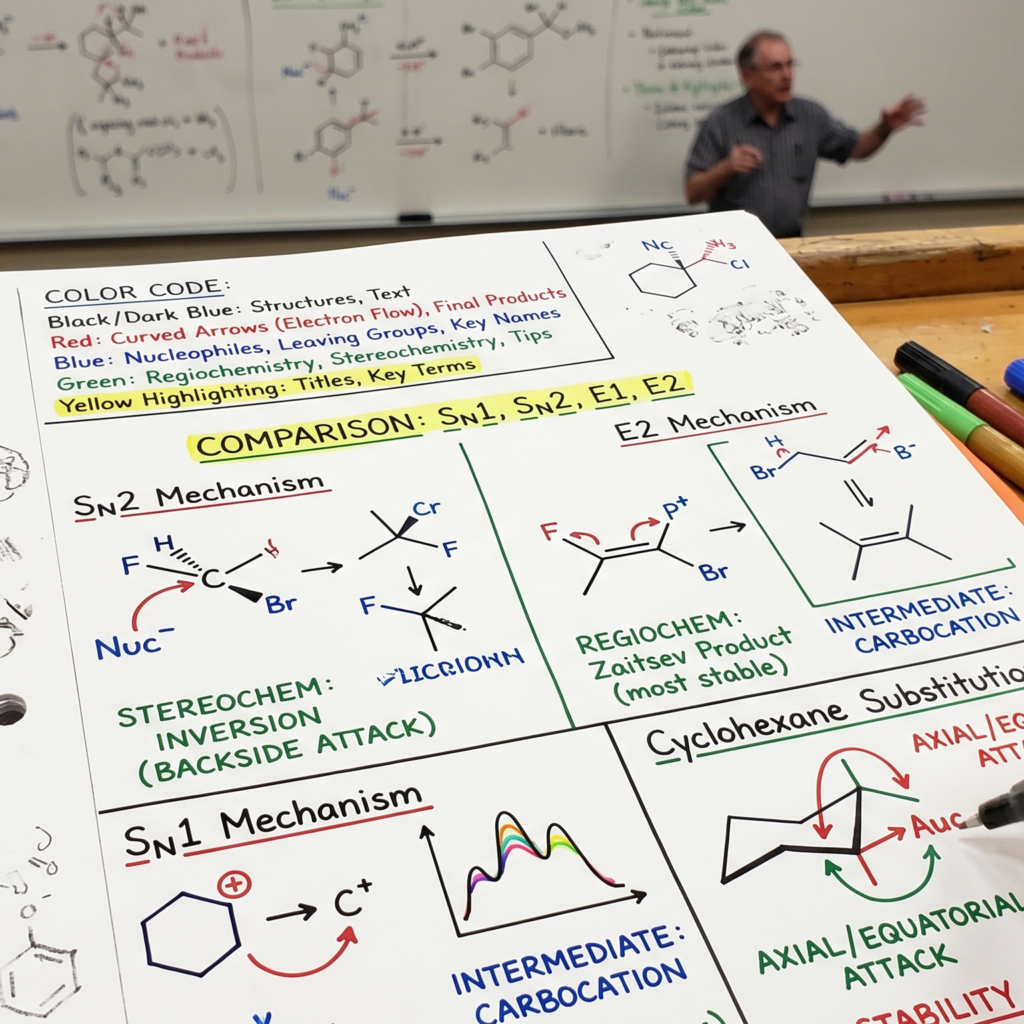
  • Using colour-coded notes to organize information.
  • Creating diagrams, charts, or visual summaries.
  • Using flashcards and study apps.
  • Connecting concepts to real-world examples.
  • Developing a personalized note-taking system that works for you.

When studying becomes interactive and enjoyable, it feels less like a chore and more like an investment in your future career.

The more positive your learning experience, the more likely you are to stay motivated and avoid putting tasks off until the last minute.

beating-procrastination-study-groups-accountability

3. Build Accountability Through Study Groups

Accountability is a powerful tool for improving productivity and academic performance.

Joining a study group or connecting with classmates can help you stay on track. When you discuss concepts, answer questions, and support each other’s learning, you’re more likely to keep up with coursework and prepare for classes consistently.

Benefits of study groups include:

  • Increased motivation
  • Better understanding of course material
  • Improved problem-solving skills
  • Reduced academic stress
  • Stronger time management habits

Knowing that others are counting on your participation can provide the extra push needed to stay focused and avoid procrastination.

4. Progress Beats Perfection

Beating procrastination doesn’t require dramatic changes overnight. It starts with small, consistent actions that build better habits over time.

As a career college student, balancing coursework with work, family, and personal responsibilities can be challenging. However, by breaking tasks into smaller steps, making studying more engaging, and creating accountability through peers, you can reduce stress, improve academic performance, and develop habits that will help in beating procrastination and strengthening your career.

Remember: success is not about being perfect. It’s about making steady progress, one step at a time.