Future-Proof Careers in an Uncertain World: Why Human-Centered Healthcare May Be One of the Smartest Career Choices Today

Future-Proof Careers in an Uncertain World: Why Human-Centered Healthcare May Be One of the Smartest Career Choices Today

Not long ago, the formula for career success seemed straightforward.

Earn a degree. Build digital skills. Find a stable office job. Climb the ladder.

For many people, that path worked well for years.

Today, however, the world of work is changing at a pace few could have predicted.

Artificial intelligence is transforming industries. Automation continues to streamline tasks that once required entire teams. Companies are reorganizing, restructuring, and adapting to new technologies faster than ever before.

As a result, many students and working professionals are asking an important question:

What careers will remain valuable in the decades ahead?

While no profession is completely immune to change, some careers possess qualities that make them remarkably resilient. These careers are built around human connection, hands-on expertise, and services that people will continue to need regardless of technological advances.

Healthcare and wellness professions stand out as some of the strongest examples.

The Future Belongs to Skills That Technology Cannot Easily Replicate

Technology is incredibly powerful.

It can process information, automate workflows, generate reports, and analyze vast amounts of data in seconds.

What it cannot do is replace genuine human care.

When someone is recovering from an injury, managing chronic pain, dealing with physical stress, or looking to improve their quality of life, they are not simply seeking information. They are seeking professional guidance, personalized treatment, and human understanding.

This distinction matters.

As technology becomes increasingly capable of handling routine tasks, the value of professions centered on direct human interaction may continue to grow.

The future of work is not necessarily about competing with technology. It is about developing skills that complement it.

Why Healthcare and Wellness Careers Continue to Stay Future-Proof

Healthcare has always been about people.

Regardless of economic cycles, market fluctuations, or technological innovation, people will continue to need support for their physical and mental well-being.

Canada’s population is aging. More individuals are prioritizing preventive care. Awareness surrounding wellness, mobility, rehabilitation, and long-term health continues to increase.

These trends are creating opportunities for healthcare professionals whose expertise helps people live healthier, more active lives.

Unlike many professions that can be performed entirely through a screen, healthcare and wellness careers often require direct interaction, physical assessment, and individualized treatment.

Every patient presents a unique situation. Every treatment plan requires professional judgment.

That human element remains at the center of effective care.

A Career That Creates Visible Impact

One of the most overlooked aspects of career satisfaction is the ability to see the impact of your work.

Many professionals spend years producing reports, attending meetings, or contributing to projects without ever witnessing the direct result of their efforts.

Healthcare is different.

Whether helping someone manage pain, recover mobility after an injury, reduce stress, or improve overall well-being, healthcare professionals often see the results of their work firsthand.

That sense of purpose is one reason many people are exploring healthcare-focused career paths, even after spending years in other industries.

For some, career success is no longer defined solely by salary or job title. Increasingly, people are seeking careers that combine professional stability with meaningful contribution.

Registered Massage Therapy: Combining Science, Skill, and Patient Care

Registered Massage Therapy continues to be one amongst several recognized healthcare and wellness professions in Canada.

Massage therapists work with individuals experiencing a wide range of concerns, from sports injuries and workplace strain to chronic pain and rehabilitation needs.

The profession combines clinical knowledge with hands-on treatment skills and strong patient relationships.

Every client brings a different story, a different challenge, and a different goal.

That combination of technical expertise and human interaction is precisely what makes the profession both rewarding and adaptable in a changing economy.

Manual Osteopathy: A Growing Interest in Whole-Body Wellness

As more people seek holistic approaches to health and wellness, interest in Manual Osteopathy continues to grow.

Practitioners focus on understanding how the body’s structure influences movement, function, and overall well-being.

The profession requires critical thinking, observation, assessment skills, and hands-on treatment techniques that are tailored to each individual.

In an era where many services are becoming increasingly standardized, personalized care remains one of healthcare’s greatest strengths.

Acupuncture: An Ancient Practice in a Modern Healthcare Landscape

Healthcare is evolving, but patients are also becoming more open to diverse approaches to wellness.

Acupuncture has gained increasing recognition as part of a broader movement toward integrative healthcare.

Practitioners help patients address concerns related to pain, recovery, stress management, and overall wellness through individualized treatment plans.

Like many healthcare professions, success depends on much more than technical knowledge alone. Building trust, understanding patient needs, and creating a positive care experience are all essential components of effective practice.

Preparing for a Career in Healthcare

For students considering healthcare careers, a strong educational foundation can open the door to a wide range of opportunities.

Programs that focus on anatomy, physiology, patient care, clinical skills, and professional development provide students with knowledge that remains relevant regardless of how technology evolves.

What is unlikely to change is the need for compassionate, skilled individuals who can apply that knowledge to improve the lives of others.

Building a Career for the Long Term

Predicting the future is impossible.

Twenty years ago, few people anticipated the technologies that shape our lives today. Twenty years from now, the workplace will undoubtedly look different again.

Yet some needs remain remarkably consistent.

People will continue to seek relief from pain. They will continue to recover from injuries. They will continue to prioritize health, mobility, and quality of life.

Careers built around supporting those needs are not simply responding to a trend—they are responding to something fundamentally human.

For students and career changers looking toward the future, healthcare and wellness professions offer something increasingly valuable: the opportunity to build practical skills, make a meaningful difference, and develop a career rooted in expertise that people will continue to need for years to come.

7 Effective Study Strategies for Adult Learners and Career College Students

Returning to school as an adult can be both exciting and challenging. Many mature students balance coursework with employment, family responsibilities, and other commitments, making effective study strategies essential for academic success.

The good news is that academic performance is not simply determined by intelligence or natural ability. Research in educational psychology consistently shows that effective study strategies have a significant impact on learning, retention, and long-term success.

The following evidence-based techniques can help adult learners maximize their study time and improve academic outcomes.

Move Beyond Passive Studying

Many students spend hours reading textbooks, highlighting notes, and reviewing course materials. While these activities can be useful as part of a study plan, they are often insufficient on their own.

Research has shown that passive review can create a false sense of familiarity with content without improving long-term retention. Students may recognize information while reading but struggle to recall or apply it during tests, assignments, or workplace situations.

Instead, learners should focus on active engagement with course material by asking questions, summarizing concepts in their own words, and testing their understanding regularly.

Use Active Recall to Improve Retention

One of the most effective learning strategies is active recall.

Rather than repeatedly reading notes, students attempt to retrieve information from memory without looking at their materials. This process strengthens memory pathways and improves long-term retention.

Examples of active recall include:

  • Answering practice questions
  • Completing quizzes
  • Using flashcards
  • Explaining concepts aloud
  • Writing summaries from memory

Research consistently demonstrates that active recall produces better learning outcomes than passive review techniques.

Practice with Multiple Question Formats

Successful students do not rely on a single type of practice material.

Exposure to a variety of question formats helps learners develop a deeper understanding of concepts and improves their ability to apply knowledge in different contexts.

Effective practice materials may include:

  • Multiple-choice questions
  • Short-answer questions
  • Case studies
  • Scenario-based exercises
  • Written assignments
  • Practical applications

This approach is particularly valuable in career-focused education, where students must demonstrate both theoretical knowledge and practical problem-solving skills.

Focus on One Concept Through Repeated Application

When students encounter challenging topics, the solution is often not more reading but more application.

Working through multiple questions related to a single concept helps learners identify gaps in understanding and view the material from different perspectives.

For example, rather than reviewing the same notes repeatedly, students should solve a variety of problems that require them to apply the concept in different situations.

This process builds confidence, strengthens critical thinking skills, and promotes deeper understanding.

Apply Spaced Repetition

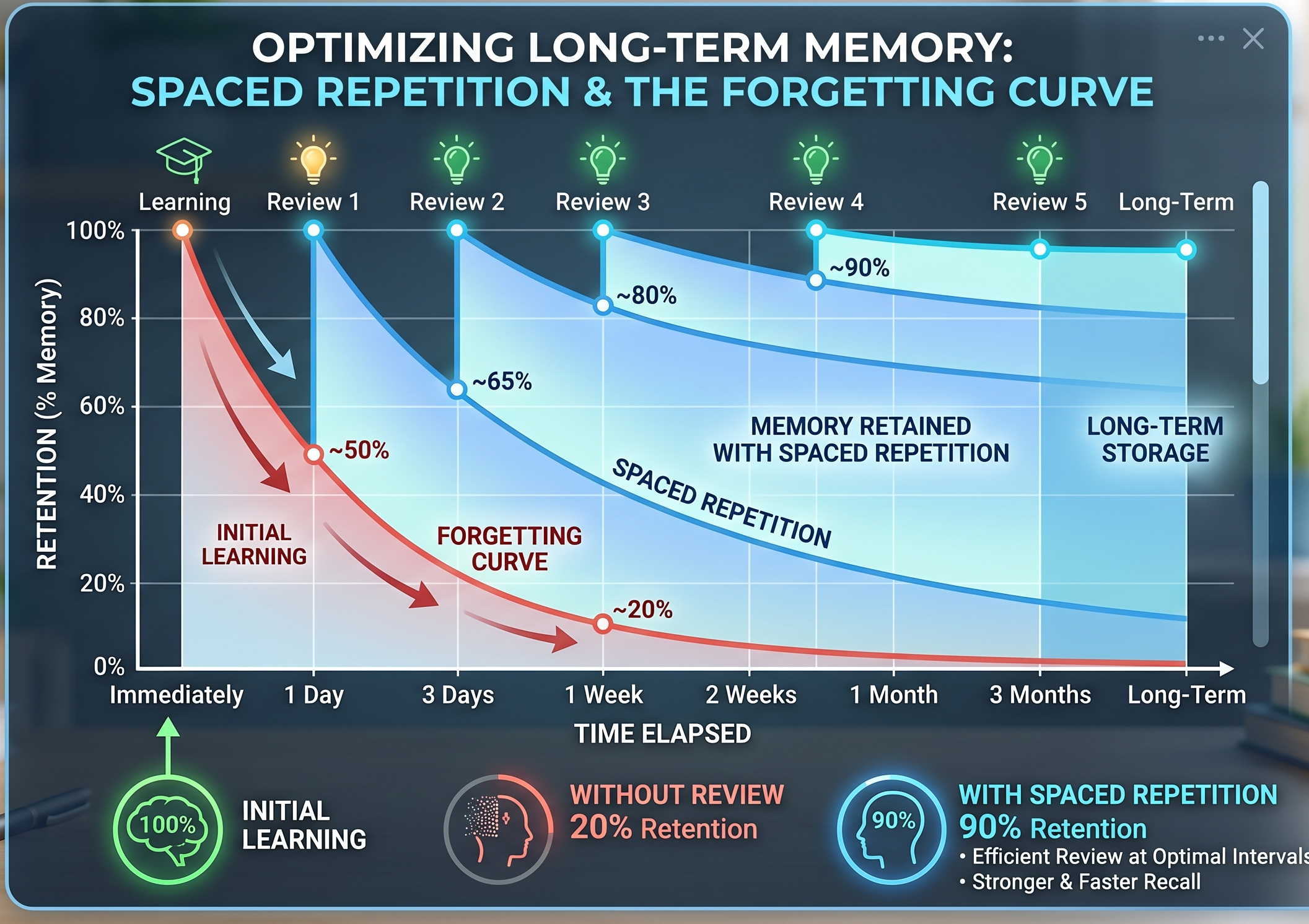
One of the most widely supported findings in learning science is the spacing effect.

Information is more likely to be retained when reviewed at intervals over time rather than studied intensively in a single session.

A simple spaced repetition schedule may involve:

  • Reviewing material shortly after class
  • Revisiting it the following day
  • Reviewing again several days later
  • Testing knowledge periodically over subsequent weeks

This method reduces forgetting and improves long-term retention.

Effective Study Strategies Spaced Recall Method

Prepare Before Class

Pre-class preparation can significantly improve learning outcomes.

Students who review lecture materials, readings, or introductory resources before class often find it easier to follow instruction and engage with complex topics.

Even a brief review session can provide important context, allowing learners to focus on understanding rather than trying to absorb entirely new information for the first time.

For busy adult learners, 15 to 20 minutes of preparation before a class can improve comprehension and reduce study time later.

Make Learning Flexible

Many adult learners must balance their studies with work and family commitments. As a result, flexibility becomes an important part of academic success.

Effective students often take advantage of small pockets of time throughout the day by:

  • Reviewing flashcards during commutes
  • Listening to educational content while travelling
  • Completing short study sessions between responsibilities
  • Using mobile learning tools to reinforce concepts

Consistency is often more important than lengthy study sessions.

Study Smarter, Not Longer

Academic success is rarely the result of simply spending more hours studying. Instead, it depends on using proven learning strategies that improve understanding, retention, and application.

For adult learners and career college students, the most effective study techniques include:

  • Active recall
  • Practice questions
  • Multiple question formats
  • Spaced repetition
  • Pre-class preparation
  • Consistent review habits

By adopting evidence-based learning strategies, students can make better use of their study time, improve academic performance, and build the knowledge and skills needed for long-term career success.

Beating Procrastination: 4 Tips for Career College Students

Why Do Students Procrastinate?

Beating procrastination is a challenge many career college students face while balancing school, work, and family responsibilities.

You come home after a long shift feeling exhausted. An assignment isn’t due until next week, so you decide to relax and tackle it tomorrow.

The next morning arrives. You feel refreshed and have some free time before starting your day. It seems like the perfect opportunity to begin your assignment. Instead, you find yourself scrolling through social media, watching videos, or catching up on other activities. Before you know it, the opportunity is gone.

As the days pass, other responsibilities take priority. Work commitments, family obligations, and unexpected events fill your schedule. Suddenly, the deadline is only a few days away. Stress begins to build, and what could have been a manageable task now feels overwhelming.

Many students know this cycle all too well. The good news is that procrastination is not a permanent habit. With the right strategies, it can be overcome.

Understanding Procrastination

Contrary to popular belief, procrastination is rarely caused by laziness. More often, it stems from feelings of anxiety, uncertainty, or being overwhelmed by the size or difficulty of a task.

When an assignment seems too large, too challenging, or too time-consuming, our brains naturally seek easier and more enjoyable activities instead. Unfortunately, delaying the task often increases stress and makes it even harder to start later.

The key to overcoming procrastination is reducing the mental barrier to getting started.

1. Focus on Small Wins

One of the most effective ways to overcome procrastination is to break large tasks into smaller, manageable pieces.

Instead of thinking about completing an entire assignment, focus on one small step:

  • Review your class notes for 15 minutes.
  • Read a single chapter.
  • Complete one practice question.
  • Create an outline for your assignment.

Small accomplishments build momentum. Once you’ve started, it becomes much easier to continue working. Many students discover that the hardest part is simply taking the first step.

This approach also helps reduce anxiety by transforming a large, intimidating project into a series of achievable tasks.

beating-procrastination-colorful-class-notes

2. Make Studying More Engaging

Successful study habits don’t have to be boring.

Students are more likely to stay consistent when they create a learning environment they enjoy. Consider:

  • Using colour-coded notes to organize information.
  • Creating diagrams, charts, or visual summaries.
  • Using flashcards and study apps.
  • Connecting concepts to real-world examples.
  • Developing a personalized note-taking system that works for you.

When studying becomes interactive and enjoyable, it feels less like a chore and more like an investment in your future career.

The more positive your learning experience, the more likely you are to stay motivated and avoid putting tasks off until the last minute.

beating-procrastination-study-groups-accountability

3. Build Accountability Through Study Groups

Accountability is a powerful tool for improving productivity and academic performance.

Joining a study group or connecting with classmates can help you stay on track. When you discuss concepts, answer questions, and support each other’s learning, you’re more likely to keep up with coursework and prepare for classes consistently.

Benefits of study groups include:

  • Increased motivation
  • Better understanding of course material
  • Improved problem-solving skills
  • Reduced academic stress
  • Stronger time management habits

Knowing that others are counting on your participation can provide the extra push needed to stay focused and avoid procrastination.

4. Progress Beats Perfection

Beating procrastination doesn’t require dramatic changes overnight. It starts with small, consistent actions that build better habits over time.

As a career college student, balancing coursework with work, family, and personal responsibilities can be challenging. However, by breaking tasks into smaller steps, making studying more engaging, and creating accountability through peers, you can reduce stress, improve academic performance, and develop habits that will help in beating procrastination and strengthening your career.

Remember: success is not about being perfect. It’s about making steady progress, one step at a time.

How to Balance Work, School, and Other Commitments

Balancing work and school can be challenging for students who are also managing family responsibilities, employment, and personal commitments. Many students today are managing multiple priorities, including employment, family obligations, volunteer activities, and academic commitments.
While maintaining this balance may seem overwhelming at first, the right strategies can help
students stay organized, productive, and successful.

1. Identify Available Time Throughout Your Day

One of the most effective time management strategies for students is learning to recognize
opportunities for productivity throughout the day.
Many students focus only on large blocks of free time while overlooking smaller periods that can
be used for studying, reviewing notes, completing assignments, or preparing for exams. Early
mornings, lunch breaks, commutes, and evenings can all provide valuable opportunities to
make progress academically.
Taking the time to assess your daily routine can reveal more study time than you may initially
expect. Even short, focused study sessions can contribute significantly to long-term academic
success.

2. Create a Structured Schedule

A well-planned schedule is essential for balancing school and work responsibilities.
Using a digital calendar or planner can help students organize classes, assignment deadlines,
work shifts, and personal commitments in one place. Scheduling dedicated study blocks
throughout the week creates consistency and reduces the likelihood of falling behind.
Setting reminders for important deadlines and upcoming exams can also help students stay on
track during busy periods.
A structured schedule not only improves organization but also helps build discipline,
accountability, and strong study habits.

3. Prioritize Tasks Effectively

When balancing multiple responsibilities, it is important to determine which tasks require
immediate attention and which can be completed later.
Creating daily or weekly task lists can help students focus on high-priority assignments while
avoiding unnecessary stress. Breaking larger projects into smaller, manageable steps can also
make workloads feel more achievable.
Effective prioritization allows students to maintain progress in both their academic and
professional responsibilities.

4. Remain Flexible and Adaptable

Even the most carefully planned schedules can be disrupted by unexpected events.
Work demands, family responsibilities, or personal commitments may occasionally require
students to adjust their study plans. Being flexible and adapting to changing circumstances can
help maintain momentum without becoming discouraged.
Successful students understand that consistency over time is more important than perfection on
any single day.

5. Make Time for Rest and Well-Being

Maintaining a healthy balance is essential for long-term success.
Getting adequate sleep, taking breaks, exercising regularly, and setting aside time for personal
interests can improve focus, reduce stress, and prevent burnout. Students who prioritize their
well-being are often better equipped to manage academic and professional responsibilities
effectively.

Final Thoughts

Balancing work, school, and personal commitments is a common challenge for today’s students,
but it is achievable with the right approach. By identifying available study time, creating a
structured schedule, prioritizing responsibilities, remaining adaptable, and maintaining personal
well-being, students can successfully manage multiple commitments while working toward their
educational and career goals.
Developing strong time management and organizational skills not only supports academic
success but also prepares students for future career opportunities

Why Acupuncture Training in Ontario Is Increasing in Popularity Among Wellness Professionals


Natural healing has increasingly become part of mainstream medicine in the past few years. More individuals are opting for treatments such as acupuncture to alleviate pain, stress, and enhance their overall health. This has also seen a high demand for qualified professionals. Overall, this is why the certification course in Ontario acupuncture has become one of the most sought-after courses for individuals starting a career in holistic health.

Whether you’re a healthcare worker, a student, or just someone searching for a new beginning, acupuncture may be the solution you’re seeking.

The Basics of Acupuncture and Why More People Are Choosing It

Acupuncture is an ancient healing technique that requires fine needles to be inserted into certain points on the body. These points restore balance to energy, ease pain, and aid in physical and mental health. Nowadays, it’s accepted all over Canada as a safe and effective means of addressing many ailments—from backaches to worries.

As more individuals seek natural remedies, skilled practitioners must be found in clinics, wellness centers, and private practices. That is why an acupuncture certification course in Ontario has become the preferred choice for wellness professionals.


Who Should Enroll in an Acupuncture Certification Course in Ontario?

If you are concerned about making people feel better naturally, you will find this course perfectly suited. The course is suitable for:

  • Students who wish to work in healthcare
  • Wellness coaches, personal trainers, or massage therapists looking to add depth to their skill sets
  • Medical workers who is ready to include acupuncture in their care plans
  • Anyone seeking a career transition into holistic health

The Ontario acupuncture certification course provides you with a respected route into this rapidly expanding sector.

What Will You Learn in the Program?

When you attend Ruhani College or another accredited school of acupuncture in Toronto, you will be learning traditional methods alongside modern science. The program entails:

  • Foundations of Traditional Chinese Medicine
  • Theory and techniques of acupuncture
  • Human anatomy and physiology
  • Needle safety, hygiene, and handling
  • Clinical practice with live clients

These subjects make you confident to practice and fulfill Ontario’s licensing standards.

Why Study Acupuncture in Canada?

Studying acupuncture in Canada provides numerous benefits:

  • Programs are of high educational value
  • Being able to work in private clinics as well as in public environments
  • Learn advanced techniques to support patients with pain, fertility, and stress issues
  • An expanding job market provincially

As there is increasing confidence in the use of natural remedies, students who successfully graduate from an acupuncture certification program in Ontario are gaining access to a solid future-oriented field.

Perks of Selecting an Acupuncture School in Toronto

Many  wellness and healthcare colleges can be found in Toronto. Studying here means access to:

  • Diverse client populations
  • Hands-on clinical training
  • instructors with years of field experience
  • Networking opportunities with other healthcare professionals

Ruhani College, located near Toronto, offers a high-quality acupuncture certification course in Ontario designed to support students every step of the way.

What Does a Career in Acupuncture Look Like?

After completing your training, there are many job options:

  • Private practice as a Registered Acupuncturist
  • Working in integrative wellness clinics
  • Partnering with chiropractors, massage therapists, or naturopaths
  • Teaching or coaching others about holistic health

The average salary for an Ontario acupuncturist is good, and many have flexible schedules and the option to be their own boss.

A certified acupuncture certification course in Ontario provides the key to all these opportunities.

Why Ruhani College Is a Choice

Ruhani College’s curriculum is designed for practical success. Here’s why it excels:

  • Affordable rates and convenient payment plans
  • Experienced instructors who care
  • Hands-on training with real clients
  • Guidance through registration and licensing procedures
  • Career counseling to assist you in finding employment once you graduate

We don’t simply train in acupuncture—we equip you for a successful and long healthcare career.

How to Get Started

It’s easy to get started. Here’s how to begin:

  1. Earn your high school diploma (or equivalent)
  2. Enroll in the acupuncture certification program in Ontario from Ruhani College
  3. Complete orientation and start training
  4. Finish both academic and clinic components of the program
  5. Pass the licensing exams to become a Registered Acupuncturist in Ontario

With complete support from our side, each step is easier.

Final Thoughts

The wellness sector is expanding rapidly—and so is the demand for compassionate, skilled professionals. If you’ve been pondering a change, the acupuncture certification program in Ontario may be the beginning of something special. If you’re attracted to holistic healing, work-life balance, or genuinely creating positive change, this profession does it all.

With Ruhani College, we’ll support you in learning, developing, and thriving—one step at a time.

Is a Pre-Medical Program the First Step for Your Healthcare Career?


Do you envision yourself in a white coat making lives healthier for others? 

If you’re a high school student questioning how to become a doctor in Canada after high school, you’re not the only one. Becoming a doctor is thrilling, but it also takes some planning and early decisions. Starting with a pre-medical program is a strong first step toward becoming a doctor.

Let’s take a look at what this journey is like, and how you can start your medical journey right out of high school.

Why Begin Your Medical Journey After High School?

Most students wait until university to seriously consider medical school. But if you become aware early on that this is your dream, then it makes sense to begin earlier. Learning to become a doctor in Canada after high school is about learning the process: academic preparation, solid science abilities, and early experience with healthcare fundamentals.

Such a well-organized medical foundation program can provide just that.

What Is a Pre-Medical Program?

A pre-medical program is a course that ensures students are well-prepared to join medical school. Pre-medical programs cover the fundamentals of the sciences—biology, chemistry, physics—and also enhance communication, critical thinking, and academic abilities. For those students struggling to understand how to become a doctor in Canada upon graduation from high school, such a program forms the ideal foundation.

At Ruhani College, our pre-medical pathway in Ontario gives students the tools and support to stay ahead in this competitive field.

Benefits of Joining a Pre Med College in Ontario

Ontario is home to some of the most trusted institutions offering pre-med programs. Enrolling in a pre med college in Ontario gives you:

  • A solid understanding of science subjects
  • Preparation for international medical school applications
  • Exposure to real medical terminology and systems
  • Mentorship and guidance from experienced mentors and health professionals

Having access to these kinds of resources early on can differentiate you from other applicants when you’re trying to figure out how to become a doctor in Canada after high school.

What Do You Learn in a Pre-Med Program?

The curriculum is modeled to resemble the medical school structure. The majority of pre-med pathway programs in Canada consist of:

  • Human Biology
  • General Chemistry
  • Organic Chemistry
  • Physics
  • Anatomy & Physiology
  • English and Medical Communication

Learning these topics early makes students confident when applying to international medical schools that do not require standardized entrance exams.

Who Should Enroll in a Pre-Med Program?

If you’re wondering how to become a doctor in Canada after grade 12, then you’re already a good candidate for a pre-medical track. These programs are ideal for:

  • Grade 12 graduates with a keen interest in science
  • Future doctors preparing to start their medical journey overseas
  • Foreign students who require a stepping stone prior to applying for medical schools in Canada, the U.S., or the Caribbean

Ruhani College accepts all ambitious learners who wish to develop their career in medicine and healthcare.

How Does a Medical Foundation Program Help You Stand Out?

Canadian medical schools are very competitive. Good grades alone are not enough sometimes. That’s where medical foundation programs fill the gap. They provide you with a year of intensive training that demonstrates to admissions teams you’re committed, ready, and already familiar with the fundamentals.

More significantly, a pre-med program solves the question of how to become a doctor in Canada after high school by offering a roadmap for applying to medical school.

Pre-Med Pathway Canada: The Intelligent Way for Motivated Students

Nationwide, an increasing number of students are opting for the pre-med pathway Canada has to offer due to its pragmatic framework and outcomes. With the appropriate program, you can avoid the confusion, establish a firm academic background, and make your application stand out.

At Ruhani College, our goal is to make sure every student not only learns the material—but also grows the confidence needed to move forward in the medical field.

What’s Next After Pre-Med?

After completing your pre-med program, the next steps may include:

  • Applying to medical schools in Canada, the U.S., or internationally
  • Pursuing further undergraduate science studies, if needed

Regardless of what path you take, knowing how to become a doctor in Canada after high school begins with the proper advice—and Ruhani College is here to help.

Final Thoughts

Whether you’re interested in healthcare and already contemplating medical school, act now. Knowing how to become a doctor in Canada after high school begins with wise decisions today.

A pre-med program prepares you educationally, psychologically, and professionally. It’s not just science courses—it’s your gateway to the healthcare universe.
Get started with Ruhani College’s reliable pre-med path in Ontario.